
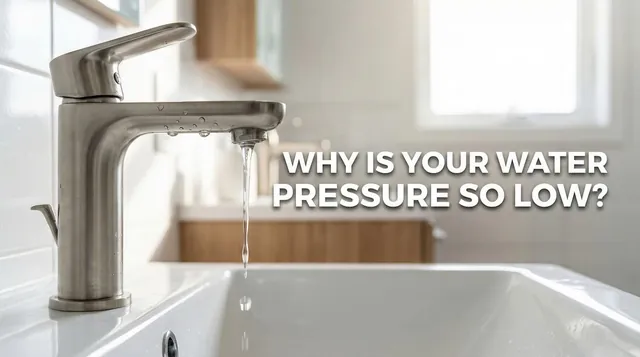
Nothing ruins a morning like a weak shower. Low water pressure is a very common problem for homeowners. It is easy to blame the city water supply, but the real issue is often inside your own house. We have broken down the causes into four simple groups. Here is why your water might be slow and when to call VPS Vancouver Plumbing Services.
- Vanco Plumbing Team
- February 8, 2026
A weak shower, a slow kitchen tap or a washing machine that takes longer to fill can all feel like low water pressure. But the right fix depends on where the problem starts: one fixture, the hot-water system, the plumbing throughout your home or the supply serving your neighbourhood.
Start by checking which taps are affected and whether the change was sudden. That simple comparison can help you avoid buying a new showerhead, adjusting a pressure regulator or replacing a water heater before you know what is wrong.
Quick answer: If just one tap is weak, check its aerator, supply valves and hose first. If every tap is weak, investigate the main shut-off valve, pressure regulator, leaks and incoming supply. If only hot water is affected, focus on the hot-water side. A sudden pressure drop with visible leaking needs prompt attention.
Start Here: Match the Symptom to the Next Check
- Only one faucet is weak: Compare hot and cold water at that faucet, then check the aerator, local shut-off valves and visible supply hoses.
- Only the shower is weak: Compare it with the bathroom sink and, if available, the tub spout. Check the showerhead and its filter screen before assuming the whole house has a problem.
- Every tap has weak hot and cold water: Check whether neighbours are affected, whether plumbing work was recently done and whether your main house valve is fully open.
- Hot water is weak at several taps, but cold water is normal: Arrange a check of the water heater connections, hot-water valves and any mixing valve or other restriction in that system.
- Flow drops when another tap or appliance runs: Compare performance with only one outlet in use. The system may have limited flow capacity or a restriction that becomes noticeable under demand.
- The problem began after a repair or shutdown: Ask the contractor to check reopened valves and debris in fixture screens.
- Several neighbouring homes lost pressure at the same time: Check municipal service notices and contact your local water provider.
These patterns narrow the investigation; they do not prove which part needs replacing.
First, Check Whether the Pressure Drop Is Urgent
Look for water pooling under sinks, a growing ceiling stain, a visibly leaking pipe or the sound of running water when fixtures and appliances are off. A major leak can reduce pressure, but small leaks may not cause an obvious change.
If there is an active leak, close the nearest accessible water isolation valve, or your main house water valve if necessary and safe to reach. Keep clear of water near electrical equipment and arrange emergency help. Do not force a seized valve.
A sudden loss of water throughout the home also needs attention. Check for a supply interruption, and in freezing weather consider a frozen pipe. Do not use an open flame to thaw plumbing. Persistent discolouration, unusual odour or an official water advisory should be handled according to your municipality’s instructions.
Is It Low Pressure or Restricted Water Flow?
Water pressure is the force pushing water through the plumbing. A gauge measures it in pounds per square inch (psi) or kilopascals (kPa). Flow is the volume coming out of a tap over time, usually measured in litres per minute.
The distinction matters because a blocked aerator can produce a weak stream even when the house has adequate pressure. Conversely, an unrestricted faucet can still perform poorly if the incoming supply pressure is low.
A gauge reading taken with all outlets closed is static pressure. A reading taken while another outlet is running shows the pressure available under that demand. Comparing the two helps explain why a shower may work well alone and weaken when someone opens another tap.
How to Check Water Pressure at Home
1. Compare fixtures before buying parts
Pause the dishwasher, washing machine, irrigation and other water use. Test the kitchen tap, a bathroom tap and the shower one at a time. Compare cold water first, then hot water carefully to avoid scalding. Note whether the problem affects one fixture, one floor or the entire property.
Repeat the comparison at another time if the problem comes and goes. Record what else was running when the stream weakened. A short video can also help a plumber understand an intermittent problem.
2. Use a pressure gauge at a suitable cold-water outlet
If you have a sound, accessible threaded hose bib, a compatible water-pressure test gauge can provide a useful reading. Remove the garden hose, make sure the tap is closed and attach the gauge following its instructions. Open the tap slowly, check for leaks at the connection and record the reading with all other water use stopped.
Next, briefly run a separate cold-water tap and record the gauge reading again. When finished, close the hose bib and follow the gauge instructions to release trapped pressure before removing it. Skip this test if the outlet is damaged, seized, inaccessible or unfamiliar.
The test point matters: an outdoor tap may be connected before the house pressure regulator. Its reading may therefore differ from the pressure supplied to indoor fixtures. Ask a plumber to confirm the connection if you are unsure.
As a reference, Watts specifies a 50 psi (about 345 kPa) factory static setting for its LF25AUB regulator. Your home’s appropriate setting depends on the system and fixture requirements. A sustained reading above 80 psi deserves professional assessment; increasing pressure should not be your first response to a weak tap.
If static pressure seems adequate but drops sharply when a tap runs, record both values. A restriction or limited supply capacity may be involved. One reading alone cannot identify the faulty component.
3. Use a container test to compare flow
For a simple comparison, time how long a cold-water tap takes to fill a container of known volume. Flow in litres per minute equals the container volume multiplied by 60, divided by the filling time in seconds. For example, 2 litres collected in 20 seconds equals 6 litres per minute.
This measures flow, not psi. Use it to compare the same fixture before and after cleaning, or with other outlets on and off. Different fixtures have different rated flow limits, so there is no single bucket-test result that proves every household tap is faulty.
Common Causes of Low Water Pressure and What to Do Next
A blocked faucet aerator or showerhead
Debris can collect in the small screen at a faucet outlet or in a showerhead filter. This is a good starting point when only one fixture has deteriorated, especially after the water supply was shut off for work.
Follow the fixture manufacturer’s cleaning instructions. For a removable aerator, protect the drain so small parts cannot fall in, note how the washer and screen fit, and gently remove and rinse the assembly. Reinstall it without overtightening and compare the flow.
Use vinegar or another cleaning solution only if the manufacturer approves it for the finish and materials. Some recessed aerators need a dedicated key. Do not drill out or remove a fixture’s designed flow restrictor to compensate for a supply problem.
A partly closed or damaged shut-off valve
A valve may remain partly closed after a repair. At an individual sink, check the local water valves and look for a visibly kinked supply hose. For problems throughout the home, locate your main house water valve and check whether it was recently operated.
A typical quarter-turn ball valve is open when its handle is parallel to the pipe. Other valve types work differently. Only operate a valve you can identify and move gently; stop if it sticks or starts leaking. An older valve may be internally damaged even when its handle appears open.
A pressure reducing valve that needs attention
A pressure reducing valve, also called a PRV or pressure regulator, controls the pressure entering household plumbing. A faulty regulator, unsuitable setting or blocked internal strainer can contribute to poor or inconsistent performance.
Have the pressure measured at appropriate points before deciding that the PRV needs replacement. Turning its adjustment screw without a gauge and the correct instructions can create excessive pressure or hide another problem. Watts requires a gauge to verify adjustments on the LF25AUB model.
A clogged filter or other treatment equipment
If your home has a whole-house filter or water-treatment system, note when it was last serviced and whether the problem began after a cartridge change. A clogged filter or an incorrectly positioned valve can restrict the supply.
Check the equipment’s manual and service indicator. A bypass comparison is useful only when the manufacturer allows it and you understand the valve positions. Do not bypass treatment needed to make your water safe. Have unfamiliar equipment checked professionally.
A hidden leak
Check accessible plumbing for drips, dampness and water pooling. Listen for a continuously running toilet, and look for changes in water use if your property is metered. A wet patch in the yard may also justify an investigation of the service line.
Meter information can help confirm unexplained water use, but access rules vary. The City of Vancouver says its property water meters should be accessed by a qualified plumber or representative. Do not open a street meter chamber or operate unfamiliar utility fittings yourself.
A leak check should also account for automatic water use, such as irrigation and appliance fill cycles. Normal pressure does not rule out a leak, and low pressure alone does not prove one.
Restricted or ageing supply pipes
Corrosion inside older galvanized supply pipes can narrow the water passage. Restrictions can also occur at fittings or along the incoming service line. Gradually worsening flow at several fixtures can justify checking the pipe material and condition.
Do not assume every weak tap is caused by mineral scale, or pour drain cleaner into supply plumbing. A plumber should identify where flow is being lost before recommending a localized repair, service-line work or a larger pipe replacement.
Demand that exceeds the available flow
A shower, irrigation system and appliance filling at once all draw from the same available supply. If performance improves when the other uses stop, schedule them separately while you investigate.
There is no universal rule that a home can support only a fixed number of appliances. Pipe size, layout, incoming pressure and the flow each outlet needs all matter. If a normal second outlet makes the first almost unusable, have the system checked rather than accepting severe loss as unavoidable.
A municipal or shared-building supply problem
Water-main work or another interruption can affect multiple properties. Check a neighbour and your municipality’s current notices. Avoid replacing household parts until you know whether the issue is outside your property.
In a condo, apartment or townhouse, tell the landlord or strata/property manager whether other units are affected. Shared valves, pressure zones, pumps or maintenance may need to be checked by the building’s contractor. Do not adjust communal equipment yourself.
Why Is Only the Hot Water Pressure Low?
First compare hot and cold water at more than one fixture. If hot water is weak at only one tap, the problem may be its local valve, hose or cartridge. A weak hot stream throughout the property points towards a restriction common to the hot-water system.
Possible areas to investigate include the heater’s inlet and outlet connections, isolation valves, a mixing valve, hot-water pipework, or a filter in a tankless system. Scale or debris can affect some components, but tank sediment alone should not be treated as a confirmed diagnosis.
Water that turns cold after several minutes is a different symptom from water that stays hot but flows slowly. Describe both temperature and flow when arranging a visit. Do not increase the heater temperature, dismantle a mixing valve or flush the heater as a pressure fix without the correct model-specific procedure.
What Can You Fix Yourself, and When Do You Need a Plumber?
Reasonable first checks are comparing fixtures, cleaning an accessible aerator according to its instructions, inspecting visible hoses and leaks, checking service notices and noting whether other water use changes the result.
Arrange a plumber if the problem affects several fixtures and those checks do not explain it, if hot water is consistently weak throughout the home, or if you suspect a faulty regulator, damaged valve, hidden leak or restricted supply pipe. An active leak, growing water damage or an unexplained sudden loss deserves prompt help.
A useful diagnostic visit should establish which fixtures are affected, measure pressure at relevant points, compare performance under demand, and check accessible valves, treatment equipment and signs of leakage. Ask the plumber to explain what evidence supports the proposed repair.
Should You Call the City, Your Building Manager or a Plumber?
In the City of Vancouver, a sudden drop across several neighbouring homes is a reason to report a potential supply problem through Van311 or 3-1-1. For a persistent problem limited to your property, check the private plumbing first and consult the City’s water-pressure guidance about the next step.
If you live in North Vancouver, West Vancouver or another Metro Vancouver municipality, use your own municipality’s water-service contact. City of Vancouver reporting routes do not apply to every community.
Tenants should report the symptoms to their landlord; condo residents should contact strata or the property manager about shared systems. Responsibility for repairs depends on where the fault is located. Municipal investigation may carry a charge when the cause is on private property, so ask about fees before booking.
How Much Does It Cost to Fix Low Water Pressure?
The cost depends on the cause, access, parts, labour and whether the visit is urgent. Cleaning or replacing a fixture screen is a different job from repairing a service line or replacing corroded pipework.
Before authorizing work, ask whether the quote includes diagnosis, call-out charges, parts, labour and tax. For a larger repair, ask about access work, restoration, permits where applicable and any follow-up testing. Also ask what happens if the first suspected component is not the cause.
A symptom alone is not enough for a dependable repair price. Use VPS Vancouver Plumbing Services’ pricing information as a starting point and request a quote for the findings at your property.
Sources and Further Reading
City of Vancouver: Problems with water quality or pressure
City of Vancouver: Investigating high water consumption and possible leaks
Watts: LF25AUB pressure regulator installation and adjustment instructions
Delta Faucet: Cleaning aerators and showerhead filter screens
Moen: Bathroom faucet low-flow troubleshooting
If the checks point to a deeper problem, our Vancouver plumbing services team can diagnose the cause and fix it.