Water rising in the shower instead of going down? That smell creeping back a week after you last cleared it? Take a breath, you're in the right place, and this is fixable. A drain that keeps blocking isn't bad luck, it's a pipe that's still coated on the inside, and a snake was never going to scrape that off. Nobody wants to plunge the same drain twice a month or find the basement floor drain backing up on a rainy Saturday.
Hydro jetting clears a blocked drain by scouring the full inside wall of the pipe with water at up to 4,000 PSI. Unlike a snake, which punches a hole through a blockage, jetting removes grease, roots and scale back to the bare pipe. Most Vancouver homes need it every 18 to 24 months; restaurants need it far more often.
VPS Vancouver Plumbing Services runs hydro jetting for houses, condos, strata buildings and commercial kitchens across Vancouver, North and West Vancouver, Burnaby, Coquitlam, Richmond, Surrey and the rest of the Lower Mainland. We camera the line before we jet and again after, so you see the pipe you paid to have cleaned.
Emergency crews are available 24 hours a day.
- Camera inspection before and after every job, recorded and sent to you
- Written warranty on workmanship
- 24/7 emergency response, including nights, weekends and holidays
- Licensed and insured; fixed written price approved before any work starts
Licensed, insured and answering 24/7 – call (604) 603-3660 and you’ll get a fixed price in writing before we pick up a tool, not a surprise on the invoice after.
What Hydro Jetting Actually Does
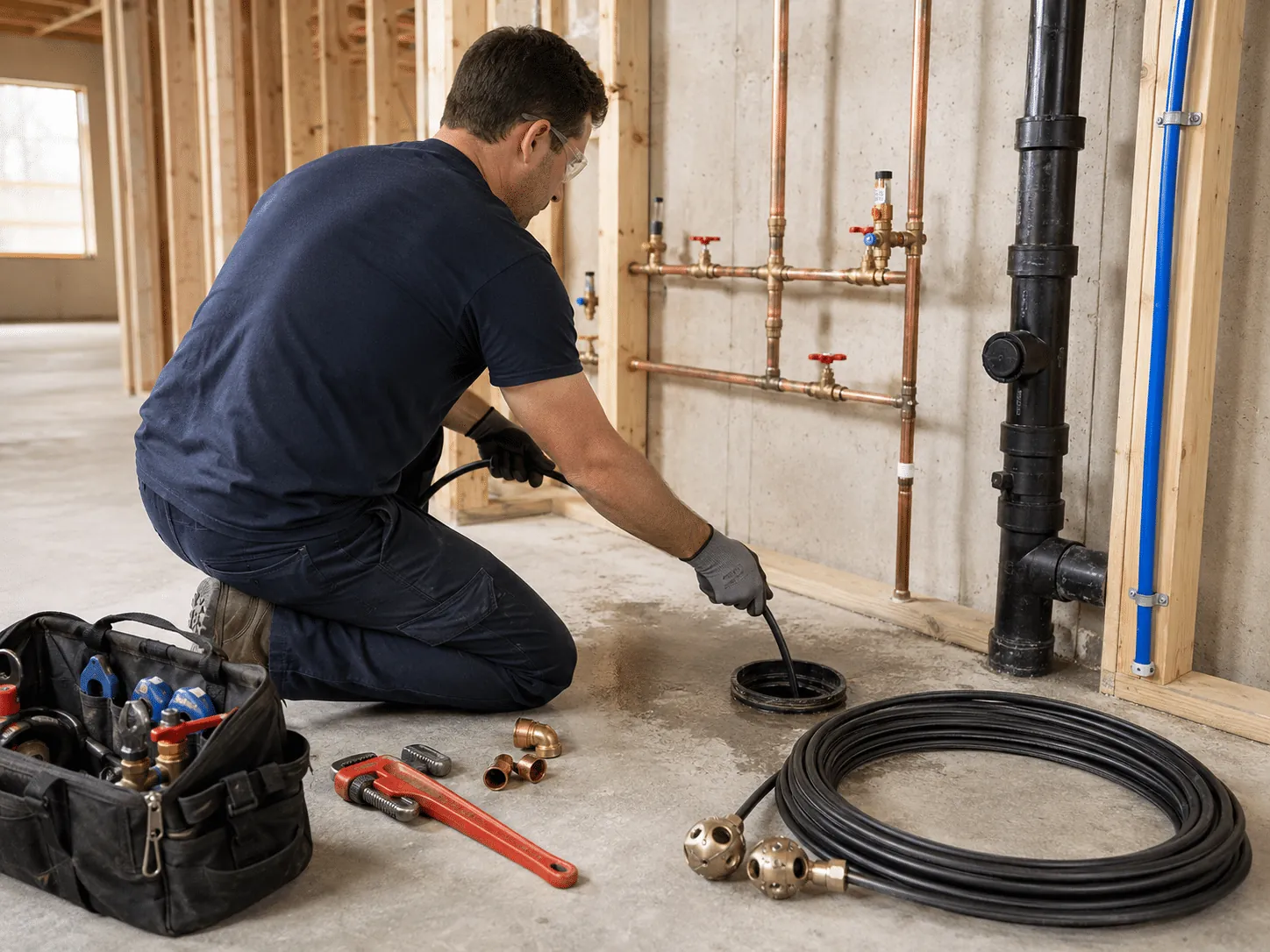
A hydro jetter is a high-pressure water pump feeding a flexible hose with a specialised nozzle on the end. The nozzle fires most of its water backwards at an angle. Two things happen at once: the rear jets drive the hose up the pipe against the flow, and the forward jet cuts into the blockage. As the hose is drawn back, the rear jets scour the pipe wall clean and flush the debris downstream to the city main.
The pressure range for residential and light commercial work is typically 1,500 to 4,000 PSI, at 4 to 18 gallons per minute. Pressure breaks the material up; flow volume carries it away. A high-pressure, low-flow machine will cut through a grease plug but leave the debris sitting in the line, which is why flow rate matters as much as the PSI number a company advertises.
Nozzles are matched to the job. A rotating or chisel nozzle is used on hardened grease and mineral scale. A root-cutting nozzle with a spinning head is used where roots have entered a joint. A flushing nozzle with a wide spray pattern is used on sand, silt and sediment in perimeter drains. Using one nozzle for every job is the most common reason a jetting service does not hold.
Hydro Jetting vs. Snaking: Which One Do You Need?
Both methods have a place, and any plumber who tells you jetting is always the answer is selling, not diagnosing. A snake (auger) is faster and cheaper, and for a single hair clog in a bathroom sink it is the correct tool. The difference shows up over the following months.
A snake bores a channel through the obstruction. Water flows again, so the problem looks solved, but the grease or root mass lining the pipe is still there and the channel closes back in. Jetting takes the pipe back to its original diameter. If you have had the same drain cleared more than twice in two years, you have been buying snaking when you needed jetting.
| Snaking (auger) | Hydro jetting | |
| What it does | Bores a hole through the clog | Scours the full pipe wall back to bare pipe |
| Best for | Single hair or object clog, one fixture | Grease, roots, scale, sediment, recurring blockages |
| Removes grease from the wall | No | Yes |
| Cuts roots at the joint | Partially, cuts the mass, leaves the stub | Yes, with a root nozzle |
| Typical time before it recurs | Weeks to months if the cause remains | 18–24 months in a normal home |
| Works on a collapsed or offset pipe | No | No, the pipe needs repair, not cleaning |
| Relative cost | Lower | Higher upfront, lower over time on repeat blockages |
| Safe on badly degraded pipe | Usually | Not always, see the next section |
The honest summary: snaking is a repair, jetting is a reset. If the same line blocks repeatedly, jetting is cheaper within two visits.
When Hydro Jetting Is Not Safe, And Why We Camera First
This is the part most drain-cleaning pages leave out. Hydro jetting is safe in sound pipe. In pipe that has already lost structural strength, 4,000 PSI can turn a partial blockage into a collapse and a cleaning bill into an excavation bill.
Vancouver has a large stock of pre-1970 housing, which means cast iron, vitrified clay and Orangeburg sewer laterals are still in daily service across Kitsilano, Mount Pleasant, Grandview-Woodland, Dunbar and much of the East Side. Orangeburg a bituminised wood-fibre pipe manufactured until the company closed in 1974 was rated for roughly 50 years of service and has been recorded failing in as little as 10. Any lateral of that era is a candidate for reduced pressure or no jetting at all.
| Pipe material | Typical working pressure | What we watch for |
| PVC / ABS (modern) | 3,000–4,000 PSI | Separated glue joints; otherwise very tolerant |
| Cast iron in sound condition | 1,500–4,000 PSI | Corrosion pits and heavy tuberculation (mineral scale) |
| Cast iron, graphitised | Jetting not recommended | Looks intact on camera but has lost its strength; needs repair or lining |
| Vitrified clay (VCP) | 1,500–3,000 PSI | Mortar joints wash out; root entry points widen |
| Orangeburg (bituminous fibre) | Below 1,200 PSI, or not at all | Delaminates and deforms; frequently collapses under pressure |
| Any pipe with a belly or offset joint | Jetting will not fix it | Water pools and re-blocks; the pipe needs re-grading or repair |
Our rule: no camera, no jet
We do not put a jetter into a line we have not seen. The camera goes in first and we look at the whole run — material, joints, grade, root intrusion, and any section that has already failed. That inspection decides three things: whether jetting is appropriate at all, what pressure and nozzle we use, and whether what you actually have is a repair job in disguise.
After jetting we run the camera a second time down the same line and record it. You get the before and after footage. If we cannot show you a visibly clean pipe wall, the job is not finished.
Sometimes the honest answer is that jetting is the wrong purchase. If the camera shows a collapsed section, a belly holding water, or Orangeburg that has gone oval, we will tell you that on the day and quote the repair instead. Cleaning a pipe that is structurally finished only buys a few weeks.
What Hydro Jetting Removes
Tree roots
Vancouver’s mature street trees and the city’s wet climate make root intrusion the most common cause of main-line blockages in older neighbourhoods. Roots find a hairline gap at a clay or cast iron joint, then thicken inside the pipe where the water is. A root nozzle cuts the mass back flush with the pipe wall. Jetting removes what is inside the pipe; it does not stop the roots returning, so where root intrusion is heavy we camera the joint and quote either a repair or a maintenance interval.
Grease and fat
Cooking fat leaves the sink as a warm liquid and cools into a solid coating a few metres down the line. It builds in layers and traps everything that passes. Hot water and store-bought drain chemicals do not remove it; they push it further along to cool somewhere less accessible. Grease is the blockage type where jetting most clearly outperforms snaking, because the problem is a coating, not a plug.
Mineral scale and sediment
Older cast iron builds up tuberculation a hard, rough mineral layer that narrows the bore and catches debris. Perimeter and storm drains collect sand and silt, which is a routine problem in Vancouver given the annual rainfall. Both respond well to jetting with the correct nozzle.
Wipes, hygiene products and construction debris
So-called flushable wipes do not break down and are a leading cause of main-line blockages in apartment and strata buildings. In recently renovated properties we also find drywall compound, grout and tile adhesive that has set inside the line.
Hydro Jetting for Vancouver Homes
For a house, jetting is usually called for on the kitchen line, the main sewer lateral running to the street, or the perimeter drainage around the foundation.
- Kitchen and laundry lines: grease and detergent scale. The classic sign is a sink that drains slowly and gurgles when the washing machine empties.
- Main sewer lateral: roots and scale. Signs are more than one fixture backing up at once, or a toilet bubbling when you run the bath.
- Perimeter drains: silt, root fibre and collapsed sections. Signs are water pooling at the foundation or a damp basement in heavy rain — a common failure in Vancouver homes built before perimeter drainage standards changed.
One point worth knowing if you own an older Vancouver property: the City of Vancouver is progressively separating combined sewers as part of the Province of British Columbia’s goal to eliminate sewage overflows by 2050, and the City has said it will consider funding sewer connection work where there is a documented history of blockages at that connection. Our camera footage and job records give you that documentation. Check your eligibility directly with the City before assuming any cost.
Commercial and Restaurant Hydro Jetting
Commercial kitchens, cafés, bakeries, grocery stores and butcher shops generate fats, oils and grease at a volume no residential line ever sees. Metro Vancouver reports that clearing the resulting build-up from the regional sewer system costs over $2.7 million each year.
If you operate a food service business in Metro Vancouver, the grease interceptor bylaw applies to you. Under Metro Vancouver’s grease interceptor requirements, an interceptor must be correctly sized and connected to all required fixtures, and it must be pumped out every 90 days or whenever fats, oils, grease and solids exceed 25% of the total liquid depth whichever comes first. You must keep records of every cleanout. Failing to install a required interceptor carries a minimum fine of $2,000, and re-inspection fees run up to $500.
An interceptor pump-out empties the tank. It does not clean the pipe run between your fixtures and the interceptor, or between the interceptor and the city main which is where the grease that caused your last shutdown is sitting. Scheduled jetting of those runs is what keeps a kitchen from closing on a Friday night.
What we do for commercial clients
- Scheduled jetting on a maintenance interval set by your actual volume, not a generic calendar
- Camera footage and a written job record for each visit, suitable for your bylaw compliance file
- Out-of-hours work so we are not jetting your kitchen line during service
- Strata and property-management coordination, including notice to residents and access scheduling
- 24/7 emergency response when a line goes down mid-service
Signs You Need Hydro Jetting Rather Than Another Snake
- The same drain has been cleared more than twice in the last two years.
- More than one fixture is slow or backing up at the same time that points to the main line, not a fixture trap.
- A toilet gurgles or the water level moves when you run a sink, bath or washing machine.
- There is a persistent sewer smell indoors or at the cleanout that returns after cleaning.
- Drains run slower every winter a classic sign of grease that has solidified as temperatures drop.
- You have mature trees between the house and the street and the property was built before 1970.
- You run a commercial kitchen and the line backs up more than once a year.
- Water pools against the foundation or the basement is damp in heavy rain.
Any one of these on its own may be a simple clog. Two or more together generally means the pipe wall is coated or roots are established, and a snake will only buy you a few weeks.
How a Hydro Jetting Job Runs, Step by Step
- Call or message us. For an active backup we dispatch 24 hours a day; for planned work we book a window that suits you.
- We locate the cleanout and camera the full run before anything else. You watch the screen with us.
- We tell you what the camera shows and what it means cleaning, repair, or both and give you a written price. Nothing starts until you approve it.
- We jet the line at the pressure and nozzle the pipe material can take, working from the cleanout toward the main.
- We camera the same line again and record it, so the result is documented rather than described.
- We flush the system, check every affected fixture, and clean up the work area.
- You get the before and after footage, the written warranty, and a recommended re-jetting interval for that specific line.
How We Price Hydro Jetting
We do not quote hydro jetting over the phone, because the two things that set the price — pipe material and what is actually in the line — cannot be assessed without seeing it. A quote given before the camera goes in is a guess, and guesses get revised upward once the crew is on site.
What we do instead:
- We camera the line first and show you what we find.
- You get one fixed written price covering the whole job before any work begins.
- That price does not change unless the scope changes, and scope changes are approved by you in writing first.
- If the camera shows the line needs repair rather than cleaning, we tell you before you have spent money on jetting that will not hold.
The variables that move the price are the length and diameter of the run, how accessible the cleanout is, the pipe material and its condition, the type of blockage, and whether the work is scheduled or an out-of-hours emergency call.
Areas We Cover
VPS Vancouver Plumbing Services proudly provides hydro jetting throughout:
- Vancouver
- North Vancouver
- West Vancouver
- Burnaby
- Coquitlam
Keeping the Line Clear After Jetting
- Never pour cooking fat, oil or grease down a sink. Let it set and bin it.
- Do not flush wipes, cotton products, dental floss or paper towel, whatever the packet claims.
- Fit a fine mesh strainer on kitchen and shower drains and empty it regularly.
- Skip caustic drain chemicals. They do not remove a grease coating, and repeated use damages older cast iron and can make a line unsafe to jet later.
- If you have trees near the lateral, book a camera check on a set interval rather than waiting for a backup.
- For a typical home, plan on re-jetting every 18 to 24 months. For a commercial kitchen, expect an interval measured in months and set it against your real volume.