
Nobody wants to be told they need a new toilet. That is the real hesitation behind most of these calls, not the fault itself, but the fear of being quoted a replacement for it. Porcelain does not wear out. What wears out are a few inexpensive parts inside the tank, and that is what most toilet problems turn out to be. If yours genuinely needs replacing we will say so plainly, but we would rather fix a cheap part than sell you a toilet.
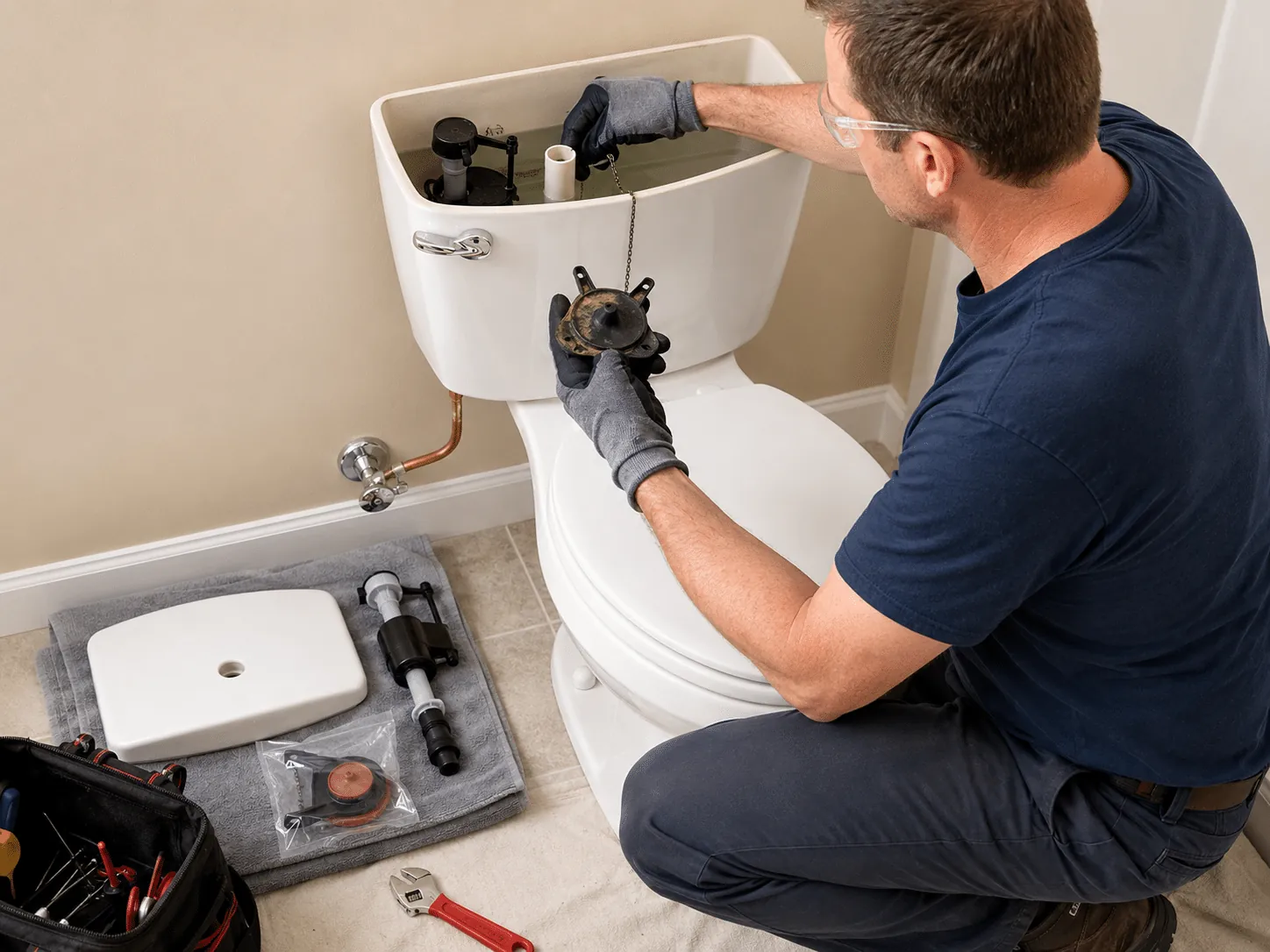
A toilet that runs is the most expensive quiet problem in a house. It makes no mess, damages nothing, and asks for no attention, so it gets none, sometimes for years. Meanwhile it is putting more water down the drain in a single day than a dripping tap manages in six months. The good news is that finding out whether yours is doing it takes fifteen minutes and costs nothing.
The dye test: 50 minutes, no tools, no cost
- Take the lid off the tank and set it somewhere flat. Porcelain lids crack easily and they are not cheap to match.
- Put a few drops of food colouring into the tank water. Any dark colour. A cheap bath bomb or a squirt of powdered drink mix works too.
- Do not flush. Wait fifteen minutes. Then look in the bowl.
- Colour in the bowl means the flapper is leaking. Water is running from the tank into the bowl continuously and the fill valve is topping it up to hide it. This is the single most common toilet fault there is, and it is also the cheapest to fix.
- Bowl still clear means the flapper is fine. If you can still hear the toilet refilling or hissing, the fault is the fill valve instead. Different part, still inside the tank, still a small job.
And a second free check while the lid is off: look at where the water sits in the tank. There is a marked fill line, or the top of the overflow tube if there is no mark. Water well below it is why a flush feels weak, and it is usually a fill valve set wrong rather than anything broken. Water at or above the top of the overflow tube means the fill valve is not shutting off ; that is water going down the overflow permanently, and it is the version of this fault that makes no sound at all.
Quick Summary
Toilet repair covers a toilet that is installed and staying: running or hissing tanks, weak flushes, leaks at the base, rocking pans and worn flappers, fill valves, flush valves and wax rings. Most faults sit inside the tank and are inexpensive parts. The ones at floor level cost more because the toilet has to come up.
VPS Vancouver Plumbing Services repairs toilets in Vancouver, Downtown Vancouver, North Vancouver, West Vancouver, Burnaby and Coquitlam, for homes, strata units and commercial properties.
Inside the Tank, at the Floor, or Not the Toilet at All
Every toilet fault lands in one of three tiers, and they are separated by cost rather than by symptom. Working out which tier you are in is the useful thing to do before calling a toilet plumber, because tier one and tier two are different conversations.
Tier 1: everything inside the tank
The tank holds three things that wear: a flapper or flush valve seal that lets the water out, a fill valve that lets water back in and shuts off, and a float that tells the fill valve when to stop. All three are inexpensive parts, all three are reachable without moving the toilet, and between them they cause the large majority of toilet calls.
The symptoms are running, hissing, phantom refilling every few minutes, a handle that needs holding down or jiggling, and a tank that fills too slowly or not far enough. None of these is urgent. All of them are cheap relative to anything in tier two, and a tank rebuild while the toilet is otherwise sound is one of the better-value jobs in plumbing.
Tier 2: anything at floor level
Below the tank the picture changes, because reaching any of it means lifting the toilet off the floor. That is the line the price crosses.
Under the pan there is a wax ring sealing the toilet to a flange, and the flange is bolted to the floor and joined to the drain. When the wax ring fails you get water appearing around the base after a flush, and often a smell. When the flange itself has broken, which happens to older cast-iron and to plastic flanges that have been over-tightened; the toilet rocks, and the rocking is what destroyed the wax ring in the first place. Replacing the ring without fixing the flange means doing it again in a year.
This tier deserves more urgency than people give it, for one reason: the water does not run across the floor where you can see it. It runs down through the flange opening into the floor structure. A wax ring that has been weeping for a year in an upstairs bathroom shows up as a stain on the ceiling below, and by then the subfloor is the expensive part, not the toilet.
Tier 3: the toilet is the messenger, not the problem
Some symptoms that appear at the toilet are not about the toilet at all. If the bowl bubbles or gurgles when the shower runs or the washing machine drains, if the water level in the bowl rises and falls on its own, or if more than one fixture is slow at the same time, the toilet is simply the lowest and widest opening into a drain that is not breathing or not clearing properly.
Replacing parts in that toilet will change nothing. What is needed is a look at the main line, which is what a camera inspection is for. Our drainage and sewer services page maps those symptoms to the right service.
What Your Toilet Is Telling You
Match the symptom to the tier. This is the table we work from when someone describes a toilet over the phone.
| What you are seeing or hearing | Usually means | Tier and urgency |
| Tank refills by itself every few minutes, nobody flushed | Flapper not sealing — water escaping into the bowl | Tier 1 · not urgent, but constant |
| A hiss that never stops | Fill valve not shutting off, water going down the overflow | Tier 1 · not urgent, but constant |
| Dye test shows colour in the bowl | Flapper or the seat it closes against | Tier 1 · book it |
| Handle must be held down or jiggled | Chain length, or a flapper closing early | Tier 1 · cheapest job on the list |
| Flush is weak or does not clear the bowl | Tank not filling to the line, or blocked rim jets | Tier 1 usually · book it |
| Tank fills very slowly | Supply valve partly closed, or a blocked fill valve screen | Tier 1 · not urgent |
| Water appears around the base after flushing | Wax ring, or the flange under it | Tier 2 · book it soon |
| Toilet rocks when you sit down | Flange or floor bolts, this is what kills wax rings | Tier 2 · book it soon |
| Water on the floor in humid weather, tank surface wet | Condensation on the porcelain, not a leak at all | No repair needed |
| Stain or damp on the ceiling below the bathroom | Leaking into the floor structure, not across it | Tier 2 · same day |
| Bowl bubbles when the shower or washer runs | Main drain or vent, the toilet is not the fault | Tier 3 · camera inspection |
| Hairline crack in the tank or bowl | Porcelain fails without warning once cracked | Replace, do not repair |
What a Running Toilet Actually Costs
This is where the numbers are genuinely surprising, so here they are from a source you can check.
BC Hydro puts a leaky toilet at up to 270 litres per day. The same BC Hydro figures put a tap dripping ten times a minute at about 2,000 litres per year. Read those two together: a running toilet can waste in roughly a week what a dripping tap wastes in a year. It is not a close comparison, and it is the reason this page leads with a free test rather than a service pitch.
Whether that reaches your bill depends on your meter. If your home is still on the flat-rate utility fee, it does not — not today. The City of Vancouver is installing meters on all residential homes that do not have one, at no cost to the owner, working toward universal metering for all customers by 2040, and the City states that once a meter goes in the property moves from a flat-rate fee to metered bills based on use. Our faucet repair page goes into that timeline in more detail.
There is a second cost that lands regardless of metering, and it is the one nobody mentions. A fill valve cycling every few minutes, all night, every night, is a small machine running continuously. It is also the reason a running toilet is the plumbing fault most likely to be discovered by a guest rather than an owner, people stop hearing it in their own house.
The Weak Flush Nobody Diagnoses Properly
“It needs two flushes” is one of the most common complaints we hear, and it is almost always blamed on the wrong thing — the low-flow toilet. Modern toilets in Vancouver are held to 4.8 litres per flush under the City’s water efficiency requirements, with the note that even the full flush on a dual-flush model must not exceed 4.8 litres. Those requirements were last updated on 19 September 2025. Four point eight litres is less than half what a 1980s toilet used, so the assumption is understandable.
It is usually wrong. A properly working modern toilet clears a bowl on one flush. When it does not, there are four causes, and three of them are cheap.
- The tank is not filling to the line. A flush is powered by the volume of water dropping at once. Two centimetres low in the tank is a noticeably weaker flush, and fill valves drift over time. This is the first thing to check and it is free.
- The flapper is closing too early. It should stay open until most of the tank has gone. A flapper that has hardened with age drops early and cuts the flush short.
- The rim jets are blocked. Water enters the bowl through small holes under the rim. When they silt up, the flush loses its swirl and stops clearing the sides. This is a cleaning job, not a parts job.
- The drain is not breathing. If the flush starts strongly and then stalls, and especially if other fixtures gurgle, the problem is downstream. See tier three above.
There is a fifth possibility worth naming honestly: a small number of first-generation low-flow toilets from the 1990s genuinely flush badly and always did. If you have one, no repair fixes the design, and replacing it is the right answer; which is the subject of the next section.
Repair or Replace? and the Money You May Be Leaving There
Most toilets are worth repairing. Porcelain does not wear out; the parts inside it do, and they are inexpensive. Four situations change that answer.
- Any crack in the porcelain, however fine. A hairline crack in a tank or bowl is not repairable and does not stay hairline. When it goes, it goes all at once with a full tank behind it.
- A broken flange in a floor that also needs attention. If the toilet has to come up anyway and the floor underneath is soft, the cost of putting the old toilet back is a poor use of the visit.
- A genuinely bad 1990s low-flow design. No part fixes it.
- An old high-volume toilet you were going to change anyway. Read the next paragraph before you decide.
If you are in Coquitlam, check the rebate before you replace
The City of Coquitlam has run a toilet replacement rebate offering a $100 credit per toilet on the water utility bill for residential property owners who replace an existing 13-litre toilet with a water-efficient model. To qualify, the new toilet must be single-flush at up to 4.8 litres, or dual-flush at a maximum of 6 litres on the high-volume flush and 4.1 litres or less on the low, and it must be certified to Canadian standards; CSA, UPC or Warnock Hersey. Applications go in within 90 days of purchase.
If your toilet is a 13-litre model and you are replacing it anyway, that is worth checking before you buy, because the certification and volume conditions decide which toilet on the shelf qualifies. Confirm the current terms with the City directly, programmes change.
Replacing a toilet rather than repairing it is a different job, and it lives on our fixture installation page. We would rather tell you that here than take a repair booking for a toilet that should be going in a skip.
When It Is Not a Toilet Repair
Routing you to the right page is more useful than taking the wrong booking.
- The toilet is blocked and will not clear with a plunger. That is a clogged drain rather than a broken toilet, see our clogged drain page. If it clears and then blocks again within days, the blockage is not in the toilet.
- More than one fixture is slow, or the bowl gurgles. Start at our drainage and sewer services page, which maps symptoms to services.
- Sewage is backing up into the bowl or the tub. Stop using water and call. That is our sewer backup emergency page.
- You want a new toilet fitted, not the old one fixed. That is fixture installation, and measure the rough-in before you buy, which that page explains.
- You are only after the price of a new toilet installed. We have a separate guide on what affects toilet installation cost in Vancouver.
- The tap next to it is dripping as well. Different job, and worth booking in the same visit, see faucet repair.
How the Job Runs
- You tell us the tier if you know it; tank, floor, or other fixtures reacting. The dye test result is genuinely useful information and it saves the first ten minutes of the visit.
- We confirm the diagnosis at the toilet. That means the tank internals, the fill level, the flapper seat, and the base and flange, because a toilet with a tank fault and a weeping wax ring is common and fixing only the noisy one is how people end up booking twice.
- You get one fixed written price before anything is replaced. If the toilet has to come up, you hear that before it comes up, with the reason.
- For tier one we replace the failed internals and set the fill level properly rather than leaving it where it was. For tier two we lift the toilet, inspect the flange and the floor around it, replace the seal and secure the pan so it does not rock.
- We flush and watch. Full flush, fill cycle, and a dry check around the base afterwards. A wax ring that is going to leak generally shows on the second or third flush, not the first.
- If the symptom points past the toilet, we say so and offer a camera inspection rather than selling you parts that will not help.
What Toilet Repair Costs in Vancouver
The honest structure first: the tier decides the price, not the symptom. Tank internals are inexpensive parts and a short visit. Anything requiring the toilet to be lifted is a longer job with more that can be found underneath, and a broken flange in an old floor is the case where a repair can turn into a bigger conversation.
We do not publish a flat rate, because the two tiers are not comparable and quoting one number would mean quoting the higher one. What we do commit to is a fixed written price before any work starts, and telling you which tier you are in before you agree to anything.
For published figures you can check yourself: Blue Monkey Plumbing, which serves West Vancouver, lists a $99 call-out fee on its running-toilet page. UrbanTasker’s 2026 Canadian plumbing cost guide puts plumber rates at roughly $90 to $200 an hour nationally, with $110 to $150 typical in major cities and higher for emergency and after-hours work. Those are their numbers, quoted because they are published and attributable.
Two things reduce what you spend. Book the toilet alongside anything else that needs doing a second fixture on the same visit costs far less than a second visit. And do the dye test first, because arriving already knowing whether the flapper is passing turns a diagnostic visit into a repair visit.
Where We Work
Toilet repair across Vancouver, Downtown Vancouver, North Vancouver, West Vancouver, Burnaby and Coquitlam.
- Vancouver and Downtown Vancouver. Apartments and strata units, where a leak at the base is never only your problem, the floor below is somebody’s ceiling. In towers we ask about the isolation arrangement before attending, because many units have no working shutoff at the toilet itself.
- North Vancouver and West Vancouver. Older detached housing with original cast-iron flanges. This is where the rocking toilet turns out to be a flange rather than a bolt, and it is worth saying on the phone if yours moves.
- Post-war houses alongside new towers; 13-litre originals in one and current 4.8-litre models in the other, which are close to opposite jobs.
- Newer detached and townhouse stock, and the municipality with a toilet replacement rebate worth checking if yours is an old high-volume model. See the rebate note above.