Shower that goes cold the moment someone flushes? Pressure that has quietly faded to a dribble? Or a drip you have started counting at night? Take a breath, most shower complaints come down to three parts, and two of them you can check yourself in ten minutes. The third is the one worth calling about, and we will help you tell which is which.
Two checks before you call anyone
- Descale the showerhead. If the pressure has dropped gradually over months in one shower only, mineral scale in the head is the likeliest cause and it is free to fix. Unscrew it, soak it in white vinegar for a few hours, poke the nozzles clear, rinse and refit. This resolves a surprising share of “low pressure” calls.
- Work out whether it is one fixture or the whole house. Run the shower, then run a bathroom tap, then a kitchen tap. If only the shower is weak, the problem is at the shower, head, cartridge or valve. If everything in the house is weak, the problem is upstream and it is a different job entirely.
If it is the whole house, the shower is not your problem, see our guide on why your water pressure is low. If it is only the shower and descaling did not fix it, read on.
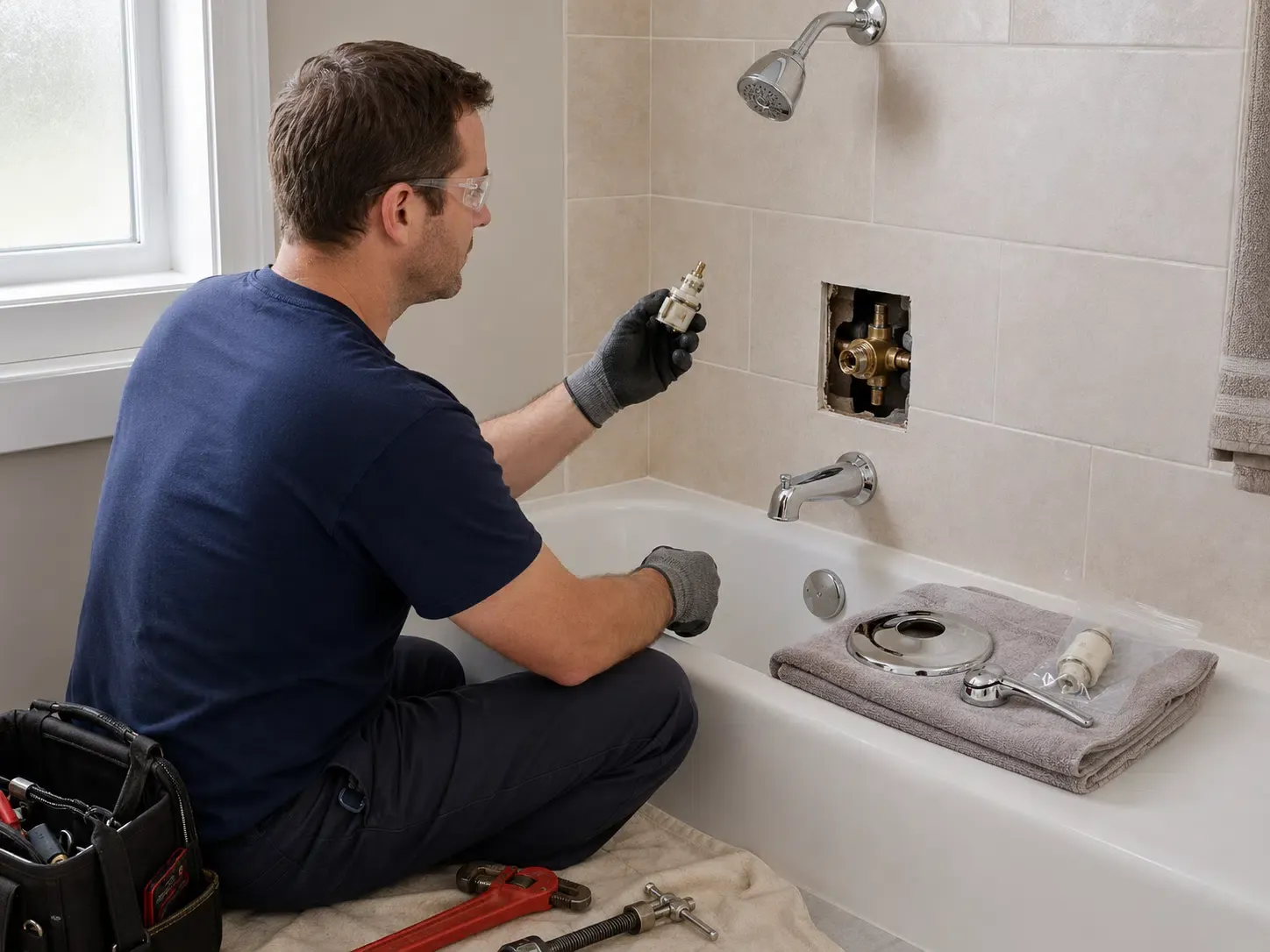
Almost every shower and tub fault traces back to one of three things: the head, the cartridge inside the mixing valve, or the valve body itself in the wall. Heads and cartridges are straightforward. The valve body is the one that decides whether you are looking at a short visit or a job with a tiling repair attached, because getting to it means opening the wall either from behind, or through the tile face.
Why Your Shower Goes Cold When Someone Flushes
Everyone has experienced this and almost nobody has been told why, so here it is.
Your shower mixes hot and cold water to a temperature you set. When someone flushes a toilet or starts a tap elsewhere, they draw cold water away from the system. The pressure on the cold side at your shower drops, the mix shifts toward hot, and you get a burst of scalding water. Run a hot tap somewhere instead and you get the opposite a cold shock.
What stops that is the valve. Modern shower valves are built to compensate, and they come in two kinds.
- A pressure-balancing valve senses the change in pressure between the hot and cold supplies and throttles one side to keep the ratio steady. It holds your temperature roughly constant through a flush. It does not hold it exactly, if the incoming hot water temperature itself changes, the valve cannot see that.
- A thermostatic valve measures the actual temperature of the water leaving the valve and adjusts continuously to hold the number you set. It handles both pressure changes and supply temperature changes. It costs more and is the better answer where two showers run at once, or where the household includes children or older adults.
So if your shower swings hard every time the toilet goes, the most likely explanations are that the valve is an older type with no compensation at all, or that it has one and the cartridge inside has worn out and stopped doing its job. The second is far more common and much cheaper to fix.
Scald protection on shower valves is a code matter, and requirements have tightened over the years; if your valve is original to an older Vancouver home, it may predate the current standard. We will tell you what you have and what the current requirement is for your municipality before recommending anything.
What Your Shower or Tub Is Telling You
| Symptom | Most likely cause | Usual fix |
| Pressure faded gradually, this shower only | Mineral scale in the showerhead | Soak the head in vinegar, free, do it yourself |
| Weak pressure everywhere in the house | Upstream, supply, main valve, pressure regulator | Not a shower job. Different diagnosis entirely |
| Temperature swings when a toilet flushes | Worn cartridge, or a valve with no pressure compensation | Cartridge replacement usually; valve replacement occasionally |
| Drips from the head after the shower is off | Worn cartridge or seats in the mixing valve | Cartridge replacement |
| Handle turns but water does not change temperature | Cartridge has failed | Cartridge replacement |
| Handle is stiff, gritty or loose on the stem | Cartridge wear or splines worn on the handle | Cartridge, sometimes handle too |
| Water seeping around the base of the tub or shower | Failed sealant, or a waste and overflow leak | Reseal, or waste replacement, worth diagnosing properly |
| Damp patch or stain on a ceiling below a bathroom | A leak behind the wall or at the waste, see next section | Call. This one does not improve with time |
| Slow-draining shower or tub | Hair and soap in the trap and branch | A drain job rather than a shower job |
| Banging pipes when the shower shuts off | Water hammer, pressure surge with nowhere to go | Arrestor fitting, or a supply issue to diagnose |
The Leak You Cannot See
A dripping head is annoying. A leak behind the shower wall is expensive, and by the time it is obvious it has usually been running for months.
Shower and tub leaks hide because everything around them is already meant to be wet. Water escaping at the valve body, at a supply connection inside the wall, or at the waste and overflow behind the tub runs down inside the structure rather than into the tray. It soaks framing, insulation and subfloor, and it announces itself on the ceiling of the room below, at which point the repair includes drywall, paint and sometimes flooring on top of the plumbing.
Signs worth acting on
- A stain, bulge or soft patch on the ceiling below a bathroom, however small.
- Flooring near the tub or shower that has started to lift, cup or discolour.
- A persistent musty smell in the bathroom that cleaning does not shift.
- Grout or sealant that keeps cracking in the same spot after being redone.
- Tiles that sound hollow when tapped, or move slightly under pressure.
- A water bill that has climbed with no change in how the household uses water.
If you have any of these, the useful thing is to find out where it is coming from before opening anything. A leak at the valve, a leak at the waste and overflow, and a failed waterproof membrane behind the tile all present the same way on the ceiling below and are three different repairs.
If water is actively running, turn off the supply to that bathroom if you can reach an isolating valve, or the main if you cannot, and call. This is one of the few plumbing problems where a few hours genuinely changes the size of the repair.
Shower Valve Replacement: the Access Question
This is the part that determines the scale of the job, and it is worth understanding before you get quotes, because it is where quotes diverge most.
The valve body sits inside the wall. To replace it, someone has to get to it. There are two routes.
- From behind. If the wall behind the shower is a cupboard, a hallway or another room with drywall, we open that side, do the work, and patch drywall. Cheaper, faster, and the repair is paint rather than tile.
- Through the tile face. If there is no access from behind, the tile comes off. That means a tiling repair afterwards, matching tile that may no longer be made, and a waterproofing detail that has to be done properly or you have created the hidden leak described above.
Before you book anyone, go and look at what is on the other side of your shower wall. If it is a cupboard, say so when you call, it materially changes the job. If it is the outside of the house or another tiled surface, expect the larger version.
When a cartridge will do instead
Most of what people assume needs a new valve actually needs a new cartridge, the replaceable core inside the valve body that does the mixing and wears out. Temperature swings, drips, a handle that has stopped controlling temperature: all usually cartridge. A cartridge is changed from the front, without opening the wall.
The valve body itself needs replacing when it is corroded, when it is an obsolete type with no cartridge still available, or when it is leaking inside the wall. A good plumber tries the cartridge first. Be wary of anyone who quotes a full valve replacement without having tried it.
Showerheads and Water Efficiency
Worth knowing if you are buying a new head, particularly a rain head or a multi-outlet system from abroad. The City of Vancouver caps showerhead flow at 7.6 litres per minute in its water efficiency requirements, updated 19 September 2025. Most heads sold in Canada meet that. High-flow imports frequently do not.
This also matters for a practical reason that has nothing to do with compliance. A large rain head at a compliant flow rate spreads the same water over a much wider area, so it can feel weaker than the small head it replaced even though nothing is wrong. If you want a rain head and you like pressure, that trade-off is worth knowing about before rather than after.
Other municipalities set their own requirements. Tell us what you are considering and we will flag anything that looks like a problem before it arrives.
How the Job Runs
- You describe the symptom. If it sounds like showerhead scale or a whole-house pressure issue, we will tell you that on the call rather than book a visit.
- On site we establish whether it is the head, the cartridge or the valve body — in that order, because that is the order of cost.
- If the valve body needs work, we check what access is available from behind before assuming the tile has to come off.
- You get one fixed written price, including any drywall or tiling implications spelled out rather than left as a surprise.
- We carry out the repair and test it properly — through a full temperature range, with another fixture run to confirm the valve compensates.
- We check for leaks at every joint we touched and leave the area clean.
- You get the written workmanship warranty and the manufacturer details for any part fitted.
What Shower and Tub Work Costs
The spread here is wider than in almost any other plumbing job, which is why nobody publishes a flat rate. A showerhead swap and a valve replacement through a tiled wall are separated by an order of magnitude, and the difference is decided by things you cannot see from the doorway.
- Which of the three parts it is. Head, cartridge, valve body, in ascending order, and by a lot.
- Whether the cartridge is still available. Common brands, easy. Obsolete or imported valves sometimes have no cartridge in production, which forces a valve replacement that a newer unit would not need.
- The access route to the valve. From behind through drywall, or through the tile face. This is the single biggest factor.
- Whether tiling repair is needed, and whether the tile can be matched. Older tile often cannot.
- Whether there is an active leak causing damage. That widens the scope beyond plumbing.
- Scheduled or out of hours. A drip can wait for Tuesday. Water coming through a ceiling cannot.
What we commit to instead: we diagnose which of the three parts it actually is, try the cheaper fix first where it is viable, and give you one fixed written price with the access implications stated before anything is opened.
If you are collecting quotes, ask each plumber whether they will try a cartridge before quoting a valve, and what happens if the tile cannot be matched. Those two answers separate the trades quickly.
Where We Work
VPS Vancouver Plumbing Services repairs showers and bathtubs throughout:
- Vancouver
- North Vancouver
- West Vancouver
- Burnaby
- Coquitlam
with 24 hour response when water is getting somewhere it should not.