Just been quoted five figures to replace your sewer line? Staring at the number and wondering if it's real? Take a breath, you're in the right place, and this is more fixable than it sounds. A failing line often doesn't need full replacement; and the only thing that can tell you which it is, is a camera, not an estimate. Nobody should be signing a contract that size based on someone's description of a pipe they can't see. This is your main sewer line — the pipe everything in the house drains through — and VPS repairs and replaces main sewer lines across Vancouver and the North Shore.
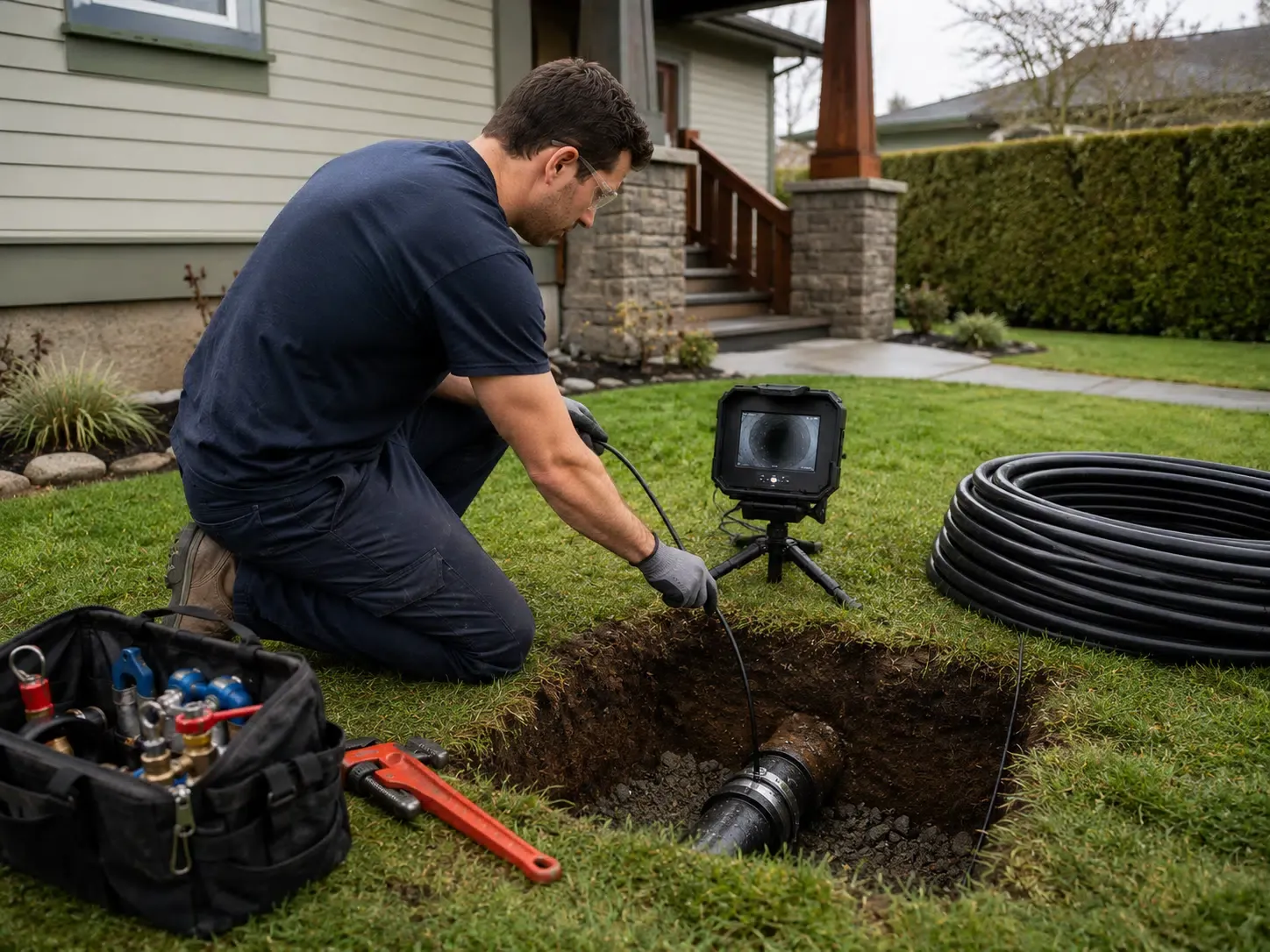
Someone has told you the sewer line needs replacing, and the number attached to it made your stomach drop. Take a breath. Before you spend anything, two things are worth knowing: a failing sewer line often does not need full replacement, and you are entitled to see the footage that proves what is actually wrong. This page explains how to tell the difference.
Sewer line repair fixes a defined fault in the pipe running from your home to the City main a cracked section, a root-invaded joint, an offset. Replacement renews the whole run, either by open excavation or by trenchless methods that need only small access pits. Which one you need is decided by camera footage, not by a phone estimate. In Vancouver, published contractor rates put a full residential lateral replacement in the five figures, while a single failed section near the cleanout is often a fraction of that.
VPS Vancouver Plumbing Services repairs and replaces sewer lines for homes and buildings in Vancouver, Downtown Vancouver, North Vancouver, West Vancouver, Burnaby and Coquitlam. We camera the line before we quote and again when the work is done, and you keep both recordings.
Repair or Replace? How to Tell Which One You Actually Need
This is the question worth the most money, so it belongs first. The honest answer is that it depends on two things only a camera can establish: how much of the run has failed, and whether the host pipe still has structural strength.
A repair is usually enough when:
- The fault is confined to one section, a cracked length, a single collapsed joint, one root entry point.
- The rest of the run shows sound pipe wall with consistent grade.
- The failure sits close to the cleanout or at shallow depth, so access is straightforward.
- The pipe material is modern PVC or ABS, or cast iron that is still structurally intact.
Replacement is the honest call when:
- There are multiple failures along the run, fix one and the next one arrives within a year or two.
- The pipe has lost structural strength: graphitised cast iron, delaminated Orangeburg, clay that has fractured along its length.
- There is a belly, a sagging section where water and solids pool. A belly is a grade problem, and no cleaning or lining corrects grade.
- The line has collapsed, or a section is missing entirely.
- Roots have entered at many joints rather than one, which is common where a clay lateral runs under mature trees.
If a plumber recommends full replacement, the fair question is simple: show me. You should be able to see, on the recording, the specific defects that make repair pointless. A recommendation you cannot see on screen is a recommendation you should get a second opinion on.
What Actually Fails in a Vancouver Sewer Line
The age of the house tells you most of what you need to know before the camera even goes in.
| Era / material | How it typically fails | Realistic option |
| Vitrified clay; common pre-1960s | Roots enter at mortar joints; sections fracture; joints offset as ground shifts | Lining if the run is sound between joints; replacement if fractured along its length |
| Orangeburg (bituminised fibre); used until the manufacturer closed in 1974 | Delaminates and deforms into an oval, then collapses | Replacement. Lining a deformed Orangeburg line is not a real repair |
| Cast iron; mid-century onward | Scale build-up narrows the bore; corrosion pits; graphitisation leaves it looking intact but brittle | Descaling and lining if sound; replacement if graphitised |
| Concrete | Interior erodes over decades, joints separate | Case by case; depends what the camera shows |
| PVC / ABS; modern | Rarely fails on its own; usually crushed by ground movement, root pressure or poor original bedding | Spot repair at the damaged section |
Two things make this a Vancouver problem in particular. The city has a large stock of pre-1970 housing, so clay and Orangeburg laterals are still in daily service across the older neighbourhoods. And mature street trees paired with a wet climate give roots every incentive to find a joint and stay there.
The Four Ways a Sewer Line Gets Fixed
Anyone who offers you only one method is describing the equipment they own, not the repair you need. There are four, and each has conditions where it is the right answer.
1. Spot repair
A short excavation over one defect. The damaged section is cut out and replaced, then the surface is restored. The least disruptive and least expensive option when the fault is genuinely isolated and the rest of the run is sound.
2. Pipe lining (CIPP: cured-in-place pipe)
A resin-saturated liner is pulled or inverted into the existing pipe and cured in place, forming a new pipe inside the old one. It needs only access points rather than a full trench, is often completed in a day, and is credited with adding up to 50 years of service life. It is the right answer when the host pipe still holds its shape and the problem is cracks, root intrusion at joints, or minor corrosion.
3. Pipe bursting
A bursting head is pulled through the old pipe, fracturing it outward while drawing new HDPE pipe in behind it. Two access pits instead of a trench. This is the trenchless option when the old pipe is too far gone to line but the route is still usable; and it can upsize the line at the same time.
4. Open excavation
A trench along the length of the run. It remains the correct method when the line has collapsed, when the grade has to be corrected, when the route itself needs changing, or when access will not allow trenchless equipment. It is more disruptive to the surface, and the cost of restoring what was above the pipe is often the largest single line item.
| Spot repair | Lining (CIPP) | Pipe bursting | Open excavation | |
| Surface disruption | One small dig | Access points only | Two pits | Full trench |
| Fixes a collapsed pipe | If localised | No | Yes | Yes |
| Fixes a belly / bad grade | No | No | No | Yes |
| Handles many root entry points | No | Yes | Yes | Yes |
| Can upsize the pipe | No | No (slightly reduces bore) | Yes | Yes |
| Typical duration | Hours | Often one day | One to two days | Several days |
| Best when | One isolated defect | Host pipe holds its shape | Pipe failed, route still good | Collapse, grade or route change |
When Trenchless Is Not an Option
Trenchless is marketed hard, and for good reason; it saves your driveway. But it has real limits, and a company that never mentions them is selling rather than diagnosing.
- A collapsed pipe cannot be lined. The liner has nothing to travel through and nothing to cure against.
- A belly cannot be lined out. The liner conforms to the existing pipe, sag included. If water pools now, it will pool inside the new liner too. Correcting grade means excavation.
- Severely corroded pipe can break under the pressure of installation. The liner needs a host with enough strength left to press against.
- Lining slightly reduces the internal diameter. On a healthy-sized lateral this is a non-issue; on a line already undersized for the building it matters and should be discussed openly.
- A missing section, a severe offset or a wrong route all need the pipe opened up.
If your line has any of these and you are being quoted a liner, ask to see the specific footage that rules them out. If it has none of them and you are being quoted a full excavation, ask why trenchless was rejected. Either way the answer should be on the recording.
What Sewer Line Work Costs in the Vancouver Area
We do not publish our own prices, because a number quoted before anyone has seen the line is a guess. What we can do is show you the published market figures so you can judge whether a quote you receive , from us or anyone else, sits in a sane range.
An independent Canadian cost index that tracks published contractor rates, supplier pricing and permit fees put full sewer line replacement in West Vancouver at $9,100 to $28,500 installed as of July 2026, with a typical figure around $14,800 for a 40 to 60 foot residential lateral. It puts published BC per-foot rates at roughly $60 to $250 for pipe bursting, $80 to $250 for lining and $100 to $250 for open excavation. For comparison, a Metro Vancouver competitor publishes a $8,000 to $25,000 range on its own sewer replacement page. Treat these as a scale, not a quote for your property.
What actually moves the number
- Length and depth of the run. Depth matters more than most people expect; a deep line at the property line is a different job from a shallow one near the house.
- What sits on top of the pipe. This is the one homeowners underestimate. The same index notes that a stamped concrete driveway, a mature cedar hedge or an interlock walkway over the line can take a job from around $10,000 to around $20,000; the pipe work barely changed; the restoration did.
- Where the failure sits. A single cracked section near the cleanout is published at roughly $1,500 to $6,000. The same defect three metres down at the property line is a materially bigger job.
- Trenchless typically runs around 10 to 30 percent more up front than open trenching, but once surface restoration is counted the total is commonly reported as 30 to 50 percent lower.
- Permit and inspection requirements, which for connection work in Vancouver can include a legal survey plan prepared by a BC-registered land surveyor.
A quote that does not itemise restoration is not a complete quote. Ask specifically what happens to the lawn, driveway or walkway, and who pays to put it back.
How to Know You Are Not Being Oversold
Sewer line replacement is one of the easiest things in this trade to oversell, because the evidence is buried in the ground and the customer usually cannot check it. Here is how to check it anyway. This applies to our quotes as much as anyone else’s.
- Insist on the recording, not a description. You should receive the camera footage as a file you keep; not a screen you were shown once on a tablet. If a company will not give you the recording, that alone is your answer.
- Ask where the defect is, in metres from the cleanout. A real diagnosis has a location. “The line is bad” is not a diagnosis.
- Ask what makes repair impossible. The answer should name a specific condition; collapse, belly, graphitisation, multiple root entries, missing section; and you should be able to see it.
- Get the quote itemised. Pipe work, access and excavation, permits, and surface restoration should be separate lines. A single lump sum hides where the money goes.
- For a five-figure quote, get a second opinion. Any reputable company expects this on a job of that size. Give the second company your footage and ask them to interpret it independently.
- Be sceptical of a same-visit, sign-now discount on major excavation work. Pressure is not a pricing strategy on a job that will still be there tomorrow.
- Ask what the warranty covers and get it in writing. Workmanship and materials are different things, and a verbal warranty is not one.
We would rather lose a job to a second opinion than win one a customer later regrets. A sewer line is not an emergency purchase unless it is actively backing up; and if it is, the emergency is stopping the backup, not signing a replacement contract at 11pm.
Does Insurance Cover Sewer Line Replacement?
Usually not, and this catches people out badly. Standard home insurance in Canada does not cover the failure of a service line on your own property. The reason is that most sewer line failures are gradual, corrosion, decay, root intrusion, material fatigue and gradual deterioration is exactly what standard policies exclude.
There is an optional endorsement, generally sold as service line coverage, that is specifically written to cover what the base policy will not: failure from wear and tear, rust, corrosion or decay. Where it applies it typically covers excavation, the repair or replacement itself, restoration of landscaping, and additional living expenses if the home is unusable during the work. It generally excludes septic systems, heating and cooling systems, sinkhole collapse and piping that was never connected.
Note that this is a different product from sewer backup coverage, which pays for damage inside the home when sewage comes back up. One covers the pipe; the other covers the mess. Many homeowners have neither and assume they have both.
We are plumbers, not insurance advisers, confirm your own position with your broker. What we can give you is the dated camera footage, the written report and the itemised invoice an adjuster will ask for.
Permits, the City, and Who Is Responsible for What
The City of Vancouver holds the property owner responsible for what is discharged into the sewer lateral from the building through to the City’s sewer main. When there is a blockage or failure, the City’s published position is that the cause determines responsibility rather than the location; and where the cause cannot be determined, responsibility defaults to the owner.
That is the practical reason to insist on camera evidence. Footage showing roots from a City street tree, a defect beyond your property line, or a failure in the City’s own main gives you something concrete to put in front of the City and your insurer. Without it, an undetermined cause becomes your bill by default.
Connection work is permitted work. The City of Vancouver requires a sewer and water connection permit before a site is connected to its systems, and the application requires a legal survey plan prepared by a BC-registered land surveyor, signed, sealed and dated within the previous six months. Fees are set out in the City’s Sewer and Watercourse By-law. Requirements differ in North Vancouver, West Vancouver, Burnaby and Coquitlam, so the permit path depends on which municipality you are in.
We handle the permit application and the inspection booking as part of the job. If a contractor proposes doing connection work without a permit, that is not a saving; it is a problem that surfaces when you sell the house.
How the Job Runs
- We camera the full run from the cleanout and record it. You get the file.
- We locate and mark the defect, and tell you how far along the run it is and how deep.
- We walk you through the footage and explain which of the four methods applies and why the others do not.
- You get an itemised written quote, pipe work, access, permits, restoration, fixed before anything starts.
- We apply for the permit and book the inspection where the work requires it.
- We carry out the repair or replacement, keeping the excavation as tight as the method allows.
- We camera the finished line and record it again, so the result is documented rather than described.
- We restore the surface as quoted, and you receive both recordings, the written report and the workmanship warranty.
What Happens to Your Yard, and How Long You Are Without Plumbing
The two questions people actually lie awake about.
- Water and drainage during the work. For most of a lining or bursting job the line is out of service only for the working portion of the day, and we tell you in advance which hours those are. On a full excavation, expect drainage to be unavailable for longer, and we will plan that with you rather than surprise you.
- Trenchless access. Lining generally needs access at the cleanout and one other point. Bursting needs a pit at each end. Lawn recovers; hard surfaces are the part worth planning around.
- Open excavation. A trench along the line, with spoil stored on site and backfilled and compacted afterwards. Anything on top of the line, driveway, walkway, hedge, retaining feature, has to come up, and putting it back is quoted separately and explicitly.
- Mature planting. Where a hedge or established tree sits over the line, say so early. It often changes which method makes sense, and it always changes the restoration cost.
Where We Work
VPS Vancouver Plumbing Services proudly provides sewer line repair and replacement and plumbing services throughout:
- Vancouver
- North Vancouver
- West Vancouver
- Burnaby
- Coquitlam
If your water heater has failed or is nearing the end of its lifespan, contact our team today for expert advice and professional installation.