
A sump pump is the only thing in your house that you find out has failed after it mattered. It works silently in the dark for years, so nobody notices when it stops, until a long November rain and a wet basement floor. You do not have to wonder: the 60-second test below tells you today whether yours will actually save you, and it costs nothing. If the answer is no, we install, replace and repair sump pumps across Vancouver and the North Shore, 24/7. Talk to a licensed plumber now; we will tell you whether you need a new pump or just a service, before you spend anything.
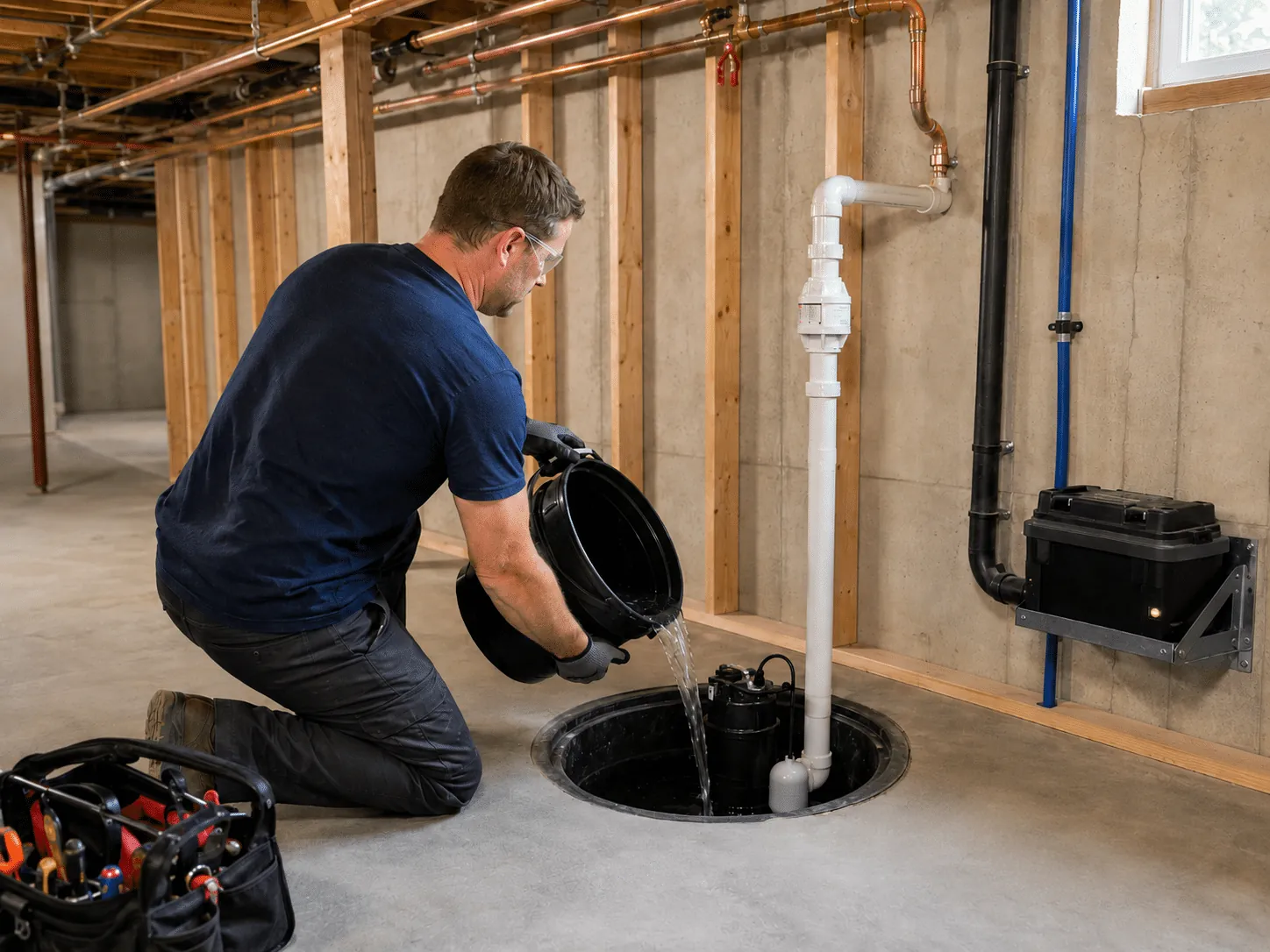
Test your sump pump in sixty seconds
- Lift the lid and look. The pit should be reasonably clear, not packed with silt, gravel or debris around the base of the pump.
- Pour a bucket of water in slowly. Enough to raise the float. Watch what happens.
- The pump should switch on by itself, run, and switch off. If the float rises and nothing happens, or it runs but the water level does not drop, that is your answer.
- Go outside and check the water is actually coming out. A pump that runs but discharges nothing usually means a blocked or frozen discharge line, or a failed check valve letting the water fall straight back in.
- If you have a battery backup, unplug the main pump and repeat. That is the only way to know the backup works. Plug it back in afterwards.
Do this once a year, in early spring before the wet season, and again in autumn if your basement has flooded before. It costs nothing and it is the difference between finding out in your own time and finding out at 2am in November.
A sump pump sits in a pit at the lowest point of a basement or crawl space and pumps out groundwater before it reaches floor level. It is what stands between a high water table and your floor during sustained rain. Typical service life is seven to ten years, or five to seven where the pump runs frequently, which in Vancouver is many of them. Where the water is allowed to discharge is regulated, and getting that wrong is both a compliance and an insurance problem.
A sump pump is one part of a property’s drainage. If water is appearing and you are not sure where it is coming from, start from our drainage and sewer services, it maps each symptom to the right service.
Do You Actually Need a Sump Pump?
Not every Vancouver home does, and we would rather say that here than at the end of a sales visit.
You probably do if
- Your basement or crawl space has taken water before, even once, in heavy rain.
- The property sits low relative to the street or at the bottom of a slope.
- There is a pit already cut into the floor, someone before you concluded you needed one.
- The basement is finished, or you are about to finish it. The cost of a pump is small next to the cost of drying out finished space.
- You have perimeter drainage that discharges to a pit rather than draining away by gravity.
- The crawl space is damp, or you get condensation and musty smell every wet season.
You probably do not if
- The property drains away from the foundation by gravity and has never taken water.
- The basement is unfinished, dry, and stays dry through a full winter.
- What you actually have is a surface water problem, blocked gutters, downspouts discharging at the wall, or grading that slopes toward the house. Fix those first; they are cheaper and they are often the whole problem.
If the water is coming in through a wall rather than up through the floor, a sump pump is not the answer either. That is a waterproofing and drainage question, and we will say so rather than sell you a pump that pumps nothing.
The Part Most People Find Out Too Late
A sump pump runs on mains power. The storm that fills your pit is the same storm that brings the power down. That is not a rare coincidence, it is the normal case, and it is the reason a basement floods with a perfectly good pump sitting in the middle of it.
So the honest framing is this: a sump pump without any backup is protection against a high water table on an ordinary wet week. It is not protection against the event you are actually afraid of.
Battery backup
A second pump on a deep-cycle battery that takes over when the mains pump loses power or cannot keep up. Runtime depends on the battery and how hard the pump has to work, and it is finite, this buys you hours, not days. The battery needs replacing periodically and the system needs testing, because a backup nobody has tested is a decoration.
Water-powered backup
Uses municipal water pressure to drive an ejector rather than electricity, so it keeps working through an outage of any length. It needs a suitable water supply, it uses potable water to move the groundwater out, and it is not permitted or practical everywhere. Where it fits, it removes the runtime limit entirely.
A high-water alarm
The cheapest useful thing you can add. It does not pump anything, it tells you the level is rising before the floor does. If budget only stretches to one addition, on a basement that is not finished, this is often the honest recommendation over a second pump.
We will lay out all three and what each one actually protects against. What we will not do is quote a battery backup as standard on a dry, unfinished basement that has never taken water.
Submersible or Pedestal?
| Submersible | Pedestal | |
| Where the motor sits | In the pit, under water | On a shaft above the pit |
| Noise | Quieter, the water muffles it | Louder, audible through the floor |
| Typical service life | Longer | Shorter under heavy use |
| Capacity | Higher, better for real volume | Lower |
| Pit size needed | Wider pit | Works in a narrow pit |
| Servicing | Pump has to come out of the pit | Motor is accessible without lifting it out |
| Cost | Higher | Lower |
| Best for | Finished basements, frequent running, real water volume | Occasional use, tight pit, tighter budget |
For most Vancouver basements that see genuine water in the wet season, submersible is the right call, the noise difference alone matters in a finished space, and the extra capacity matters when it rains for nine days straight. Pedestal earns its place in a narrow pit, in unfinished space, or where the pump runs rarely.
Where the Water Is Allowed to Go
This is the part that separates a compliant installation from one that causes a problem later, and it is worth understanding before anyone starts cutting concrete.
Most Metro Vancouver municipalities prohibit connecting a sump pump to the sanitary sewer. Groundwater in the sanitary system overloads treatment capacity, which is exactly what the City of Vancouver’s ongoing sewer separation programme, working toward the Province of British Columbia’s goal of eliminating sewage overflows by 2050, is trying to undo. A sump discharging into sanitary is working against that, and it is not permitted.
What is generally acceptable: a connection to an approved storm drain, a dedicated stormwater lateral, or discharge to permeable ground properly graded away from the building, usually a minimum of about two metres from the foundation. What is not: discharging onto a sidewalk or driveway, dumping it at the base of your own foundation wall so it simply returns to the pit, or routing it onto a neighbouring property.
The consequences of getting it wrong are not theoretical. Municipalities can require redirection, apply fines or utility surcharges, and an improper discharge can complicate an insurance claim after a flood.
Rules differ between Vancouver, North Vancouver, West Vancouver, Burnaby and Coquitlam. We confirm the requirement for your municipality as part of the job rather than assuming, and we route the discharge to comply rather than to whatever is closest.
What an Installation Actually Involves
Five things decide whether yours is a straightforward job or a bigger one, and you can work most of them out before we arrive.
- Is there already a pit? Dropping a new pump into an existing, sound pit is a short job. Cutting a new pit into a concrete slab, excavating it, setting a liner and making good the floor is a different scale of work entirely.
- Where does the discharge go? The route from the pit to an approved discharge point is often the largest variable. A short run to an existing storm connection is simple. A long run around the building, under a path, or up to a higher grade is not.
- Is there power at the pit? A sump pump needs a dedicated GFCI-protected outlet. Many older basements do not have one where the pit is, and that turns part of the job into electrical work.
- Is there a check valve? Without one, the water in the discharge pipe falls straight back into the pit each time the pump stops, and the pump short-cycles itself to an early death. It is a small part that prevents a common failure.
- Does the perimeter drainage feed the pit? If it does, the condition of that drainage matters as much as the pump. A pump keeping up with a silted perimeter system is treating the symptom.
Freezing
Vancouver winters are mild but not reliably above freezing. A discharge line that freezes has the same effect as a pump that has failed — the water has nowhere to go. Discharge routing should account for that, with adequate fall and no low points where water can sit.
Signs Your Existing Pump Is on the Way Out
- It runs constantly, or cycles on and off every minute or two — usually a check valve problem or a pump undersized for the volume.
- It makes a grinding, rattling or screeching noise rather than a steady hum.
- It vibrates hard enough to move in the pit.
- It runs but the water level does not drop, or nothing comes out at the discharge point.
- It only starts when you jiggle the float, or the float is snagged on the pit wall or the cable.
- There is visible rust or corrosion on the body.
- It is more than seven years old and you do not know when it was last tested.
Typical service life is seven to ten years, and five to seven for a pump that runs frequently. Replacing a nine-year-old pump before the wet season is a scheduled job at a scheduled price. Replacing it during a storm is not.
Keeping It Working
| What | How often |
| Bucket test — pour water in and watch it cycle | Once a year, early spring before the wet season |
| Check the pit for silt, gravel and debris | Annually, at the same time |
| Check the inlet screen and clear it | Annually |
| Check the discharge point outside is clear and draining away | Annually, and after any hard freeze |
| Replace the float switch | Roughly every two years, it is usually the first thing to fail |
| Test the battery backup by unplugging the main pump | Annually, and replace the battery on the manufacturer’s schedule |
| Check for rust and corrosion on the body | Annually |
| Replace the pump | Every 7–10 years, or 5–7 if it runs frequently |
If you do only one of these, do the bucket test. It takes a minute and it catches most failures before they matter.
What Sump Pump Work Costs in Vancouver
We do not publish our own prices, because the range between a like-for-like swap in an existing pit and a new pit cut into a slab with a long discharge run is very wide. What we can do is show you the published market figures so you can sanity-check any quote you receive, from us or anyone else.
A Vancouver plumbing cost guide published for 2026 puts a submersible pump at roughly $1,000 to $2,500 installed and a pedestal at $700 to $1,500. Replacing a pump in an existing pit is put at around $600 to $1,200, while a new installation including cutting and setting the pit is $2,500 to $4,500. A battery backup system adds roughly $500 to $1,200, and a water-powered backup $600 to $1,500. Treat these as a scale rather than a quote for your property.
What moves the number
- Whether there is an existing pit, or one has to be cut and excavated.
- The length and route of the discharge line to an approved discharge point.
- Whether there is a suitable GFCI outlet at the pit or electrical work is needed.
- Pump capacity, which follows from how much water the pit actually takes.
- Whether you add a backup, and which kind.
- Access, a tight crawl space is a slower job than an open basement.
Our quote is fixed and in writing before anything starts, and it itemises the pump, the pit work, the discharge run and any electrical separately so you can see where the money goes.
How the Job Runs
- We look at where the water is actually coming from before recommending a pump. If the problem is surface water or grading, we say so.
- We check the existing pit and pump if there is one, and test it rather than assume.
- We confirm the discharge requirements for your municipality and identify an approved discharge point.
- You get an itemised written price, pump, pit work, discharge run, electrical, any backup fixed before work starts.
- We install, fit a check valve, and route the discharge with proper fall and no low points.
- We test the pump under real water, confirm it discharges where it should, and test any backup by cutting the power to the main pump.
- We show you where the reset is, how to do the bucket test, and when to do it.
- You get the written workmanship warranty and the manufacturer warranty details for the unit.
Where We Work
VPS Vancouver Plumbing Services installs, replaces and repairs sump pumps throughout:
- Vancouver
- North Vancouver
- West Vancouver
- Burnaby
- Coquitlam
Discharge requirements differ between these municipalities and we confirm yours as part of the job.